Built upon a high-torque dual-axis base, the Radar-X serves as an intelligent “Robotic Neck” that can be outfitted with a suite of advanced sensors to perceive, track, and protect its environment.
The Radar-X isn’t just a robot—it’s a Modular Gimbal Platform. Designed with a high-torque dual-axis “neck,” it mimics the movement of industrial satellites and autonomous rovers.
Dual-Axis Precision: 180° of vertical and horizontal movement.
Plug-and-Play Architecture: Swap between LDR, Sonar, and Flame sensors in seconds.
AI-Ready: Fully compatible with the Vision-X (ESP32-CAM) for real-time facial tracking.
Zeon Core PCB: A custom-engineered board that eliminates messy wiring for a professional “out-of-the-box” experience.
KEY PROBLEMS
ZEON RADAR-X: 4 Specialized Experiments
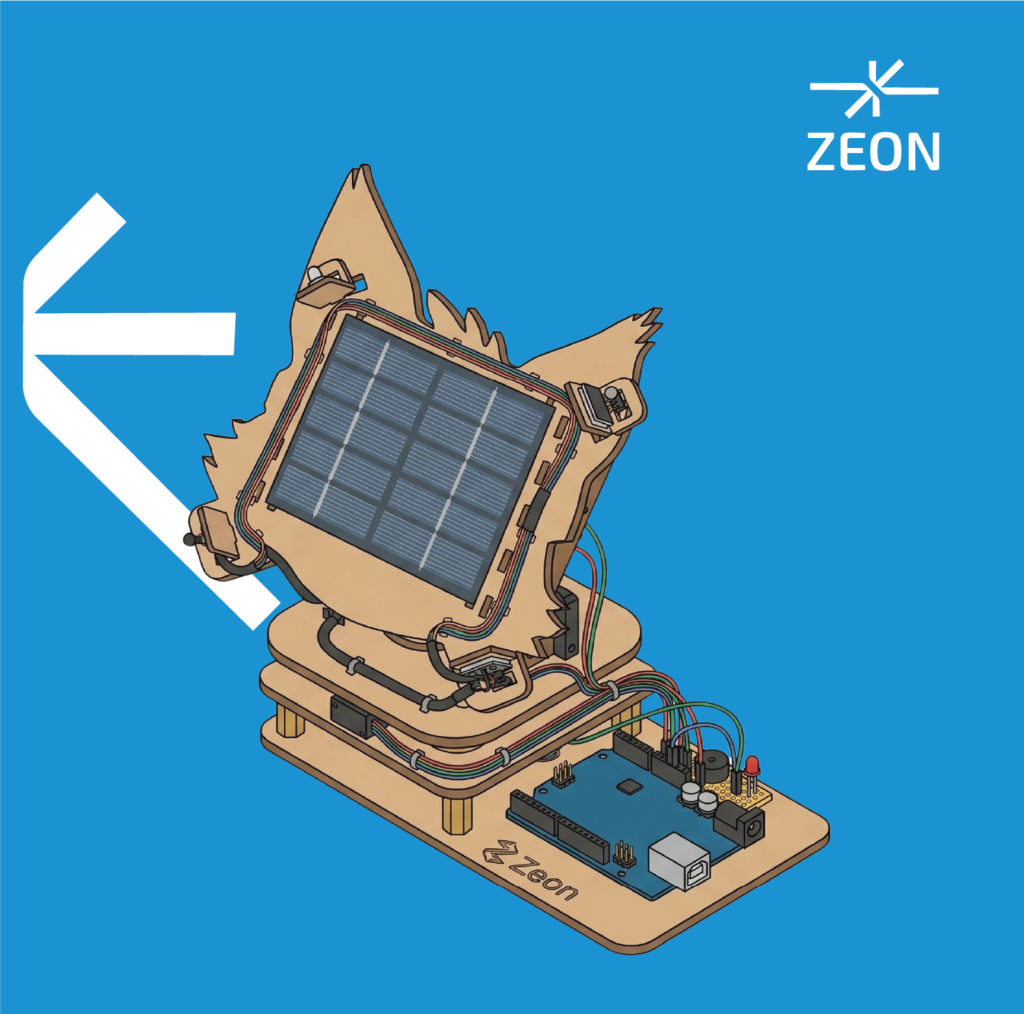
The Energy Architect (LDRs)
The Mission: Maximize Renewable Efficiency.
The Experiment: Students build the “Four-Quadrant” array. They must write code that compares the average of the Top Pair vs. Bottom Pair and Left Pair vs. Right Pair.
The Experiment: Mount the Sonar sensor to the top. The base now acts like a Radar Scanner. The motors move the “neck” in a 180° arc while the Sonar maps the distance to objects in the room.
The Experiment: Introduce “Priority Interrupts.” The robot tracks the Light normally, but the Flame Sensor acts as a “Panic Button.” If fire is detected, the robot must immediately point the panel away.
The Experiment: The base is no longer looking for heat or light; it’s looking for people. Using the CAM, the robot performs “Face Tracking.” It moves the dual-axis base.